

左右滑动查看 · 点按放大 Swipe · Tap to enlarge
图 / Image 2 · 局部 · Details点击图片放大 · Click to enlarge
观看描述Visual Description
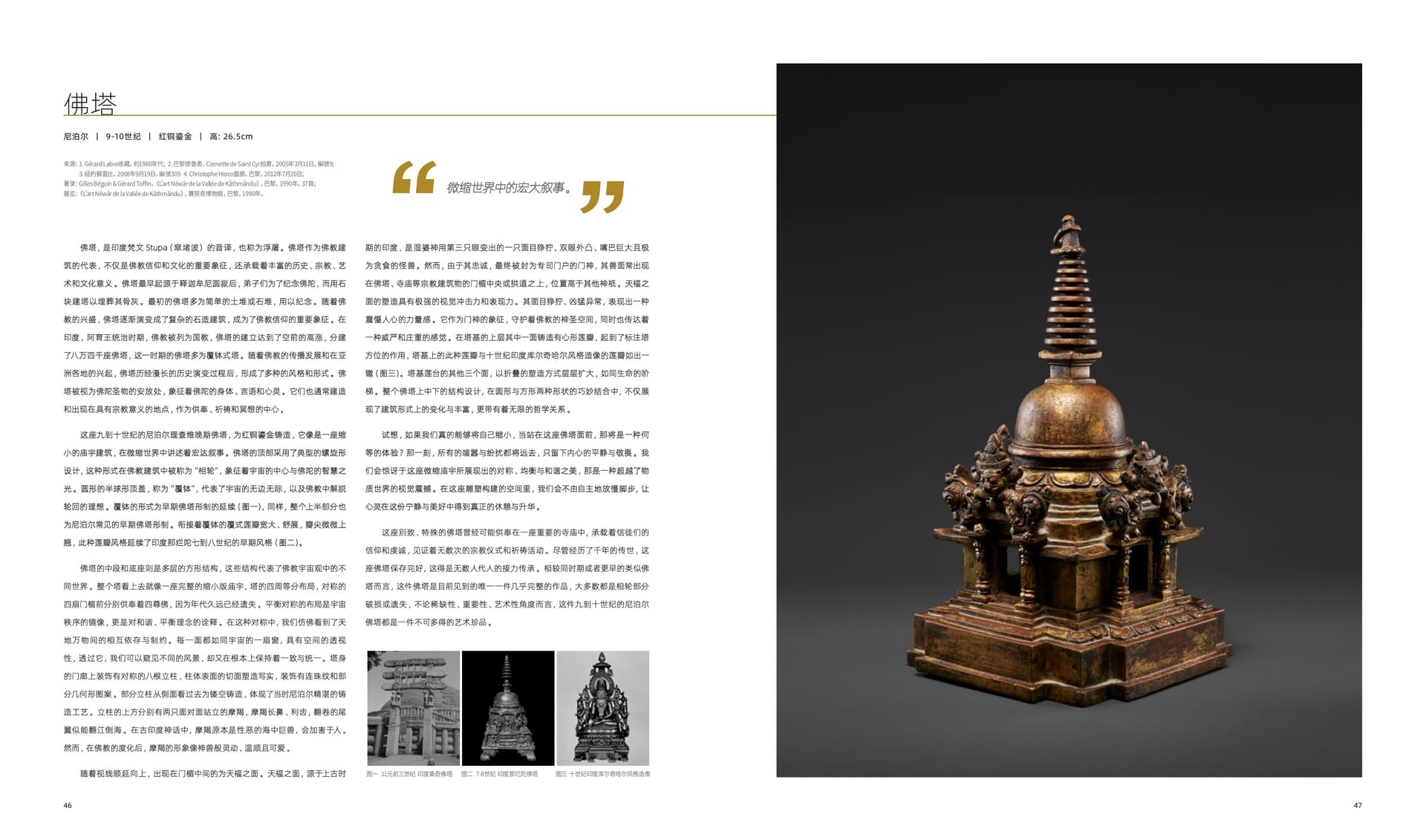
佛塔,是印度梵文 Stupa(窣堵波)的音译,也称为浮屠。佛塔作为佛教建筑的代表,不仅是佛教信仰和文化的重要象征,还承载着丰富的历史、宗教、艺术和文化意义。佛塔最早起源于释迦牟尼圆寂后,弟子们为了纪念佛陀,而用石块建塔以埋葬其骨灰。最初的佛塔多为简单的土堆或石堆,用以纪念。随着佛教的兴盛,佛塔逐渐演变成了复杂的石造建筑,成为了佛教信仰的重要象征。在印度,阿育王统治时期,佛教被列为国教,佛塔的建立达到了空前的高涨,分建了八万四千座佛塔,这一时期的佛塔多为覆钵式塔。
The *stupa* (Chinese: *fota* or *futou*) is a transliteration of the Sanskrit term *Stupa*. As the quintessential form of Buddhist architecture, the stupa serves not only as a vital symbol of Buddhist faith and culture but also embodies profound historical, religious, artistic, and cultural significance. The origins of the stupa trace back to the period following the *parinirvana* (passing) of Siddhartha Gautama (the Buddha); to honor his memory, his disciples constructed stone mounds to enshrine his cremated remains.
来源Provenance
Gérard Labre收藏,約1980年代
Collection of Gérard Labre, circa 1980s
巴黎德魯奧,Cornette de Saint Cyr拍賣,2005年3月11日,編號9
Cornette de Saint Cyr, Hôtel Drouot, Paris, 11 March 2005, Lot 9.
紐約蘇富比,2008年9月19日,編號309
Sotheby's New York, 19 September 2008, Lot 309
Christophe Hioco藝廊,巴黎,2012年7月20日;
Galerie Christophe Hioco, Paris, 20 July 2012
展览Exhibitions
《L'art Néwâr de la Vallée de Kâthmându》賽努奇博物館,巴黎,1990年。
*L'art Néwâr de la Vallée de Kâthmându*, Musée Cernuschi, Paris, 1990.
賽努奇博物館
Musée Cernuschi
1990年
竹瑾居2024年展览
Zhu Jin Ju 2024 Exhibition
北京嘉德艺术中心
Guardian Art Center, Beijing
2024年
出版Publications
Gilles Béguin & Gérard Toffin,《L'art Néwâr de la Vallée de Kâthmându》
Gilles Béguin and Gérard Toffin, *L'art Néwâr de la Vallée de Kâthmându*
1990年
第37页
Page 37
竹瑾居2024年展览图录
Zhu Jin Ju: 2024 Exhibition Catalogue
2024年
第46页
Page 46
图录中的这件作品 In the Catalogue
竹瑾居|喜马拉雅艺术 2024 展览图录
Zhu Jin Ju | Himalayan Art: 2024 Exhibition Catalogue
第 46 页 · p. 46
翻到此页阅读 Open at this page →