


左右滑动查看 · 点按放大 Swipe · Tap to enlarge
图 / Images 2–3 · 局部 · Details点击图片放大 · Click to enlarge
观看描述Visual Description
我们经常会听到一种叙事:一个王朝刚刚兴起时,政治有活力,经济有余裕,社会也更愿意创造,于是艺术跟着蓬勃;等到王朝走向后期,活力消退,作品也慢慢变得程式化。久而久之,“早期”几乎天然带着一种黄金时代的光环。
尼泊尔艺术也常常被这样理解。
尤其谈到13—14 世纪的早期马拉造像,无论在收藏还是市场语境里,人们往往会对它多一分偏爱。
We are familiar with the story: when a dynasty is newly established, political life is vigorous, the economy has room to grow, society is open to new possibilities, and art flourishes alongside it. As the dynasty enters its later years, that vitality begins to wane, and artistic production gradually settles into convention. In time, the word “early” itself comes to carry an almost automatic association with a golden age.
Nepalese art is often understood this way.
来源Provenance
1965年8月17日购自 The Handicrafts & Handlooms Exports Corporation of India Ltd.,新德里。
Acquired from The Handicrafts & Handlooms Exports Corporation of India Ltd., New Delhi, 17 August 1965.
Robert Rousset,巴黎。
Robert Rousset, Paris (1901–1981).
Jean-Pierre Rousset,巴黎。
Jean-Pierre Rousset, Paris (1936–2021).
展览Exhibitions
竹瑾居2026年展览
Zhu Jin Ju Exhibition 2026
北京嘉德艺术中心
Guardian Art Center, Beijing
2026
出版Publications
竹瑾居2026年展览图录
Zhu Jin Ju 2026 Exhibition Catalogue
2026年
第84–89页
pp. 84–89
图录中的这件作品 In the Catalogue
竹瑾居|喜马拉雅艺术 2026 展览图录
Zhu Jin Ju | Himalayan Art: 2026 Exhibition Catalogue
第 84–89 页 · pp. 84–89
翻到此页阅读 Open at this page →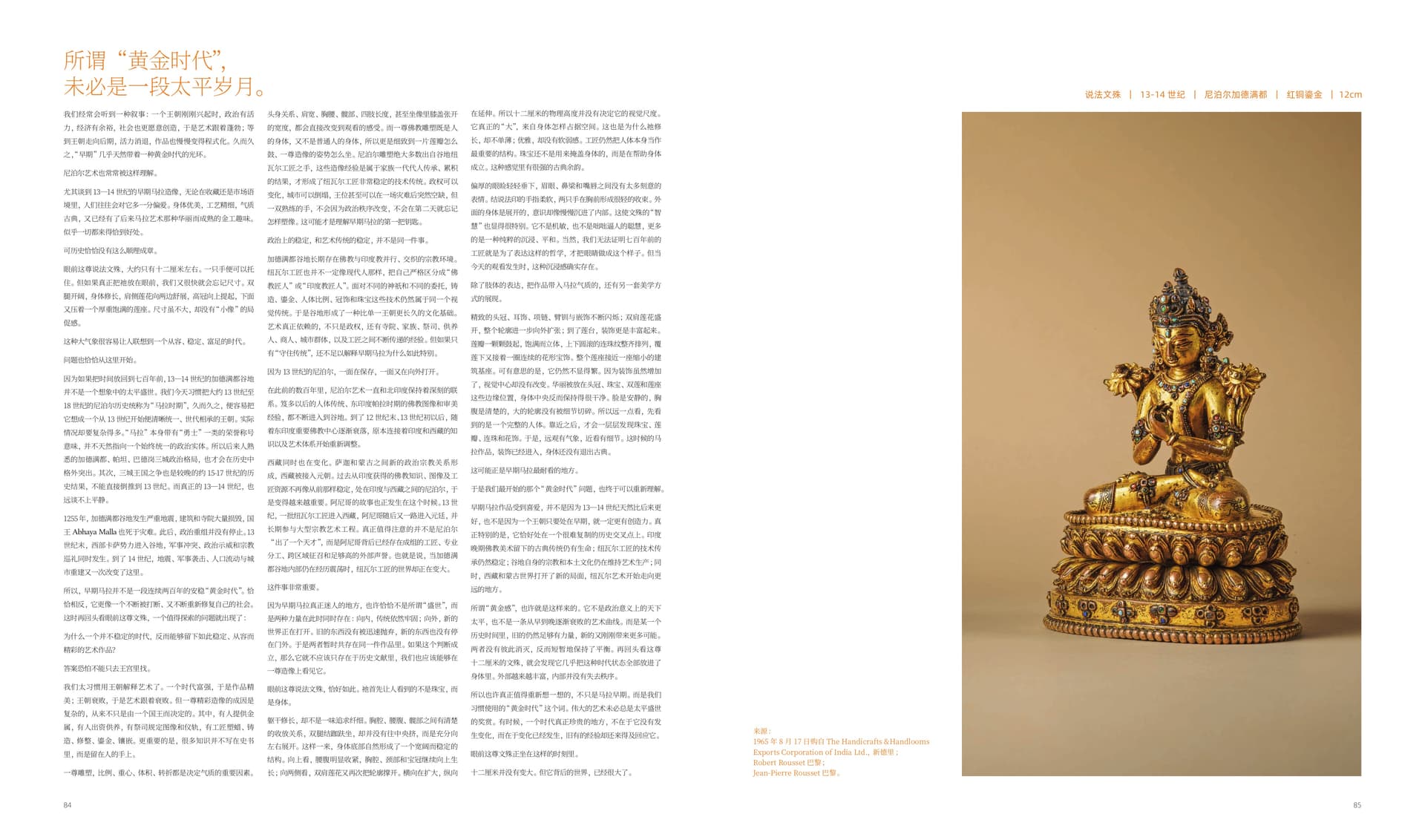
 释迦牟尼Shakyamuni Buddha西藏后藏,13–14世纪 · 红铜鎏金 · 13 cmTsang, Tibet, 13th–14th century · Gilt copper · 13 cm已洽购Acquired
 帕木竹巴·多吉杰布肖像Portrait of Phagmodrupa西藏,13–14世纪 · 合金铜、嵌红铜、嵌银 · 8.5 cmTibet, 13th–14th century · Copper alloy with copper and silver inlay · 8.5 cm已洽购Acquired
 佛手Hand of a Buddha尼泊尔,6-7世纪 · 红铜鎏金 · 20.5 cmNepal, 6th–7th century CE · Gilt copper · 20.5 cm可洽询Available
 佛说母鹿经A doe nursing her fawn尼泊尔,15–16世纪 · 红铜鎏金 · 8.5 cmNepal, 15th–16th century · Gilt red copper · 8.5 cm已洽购Acquired